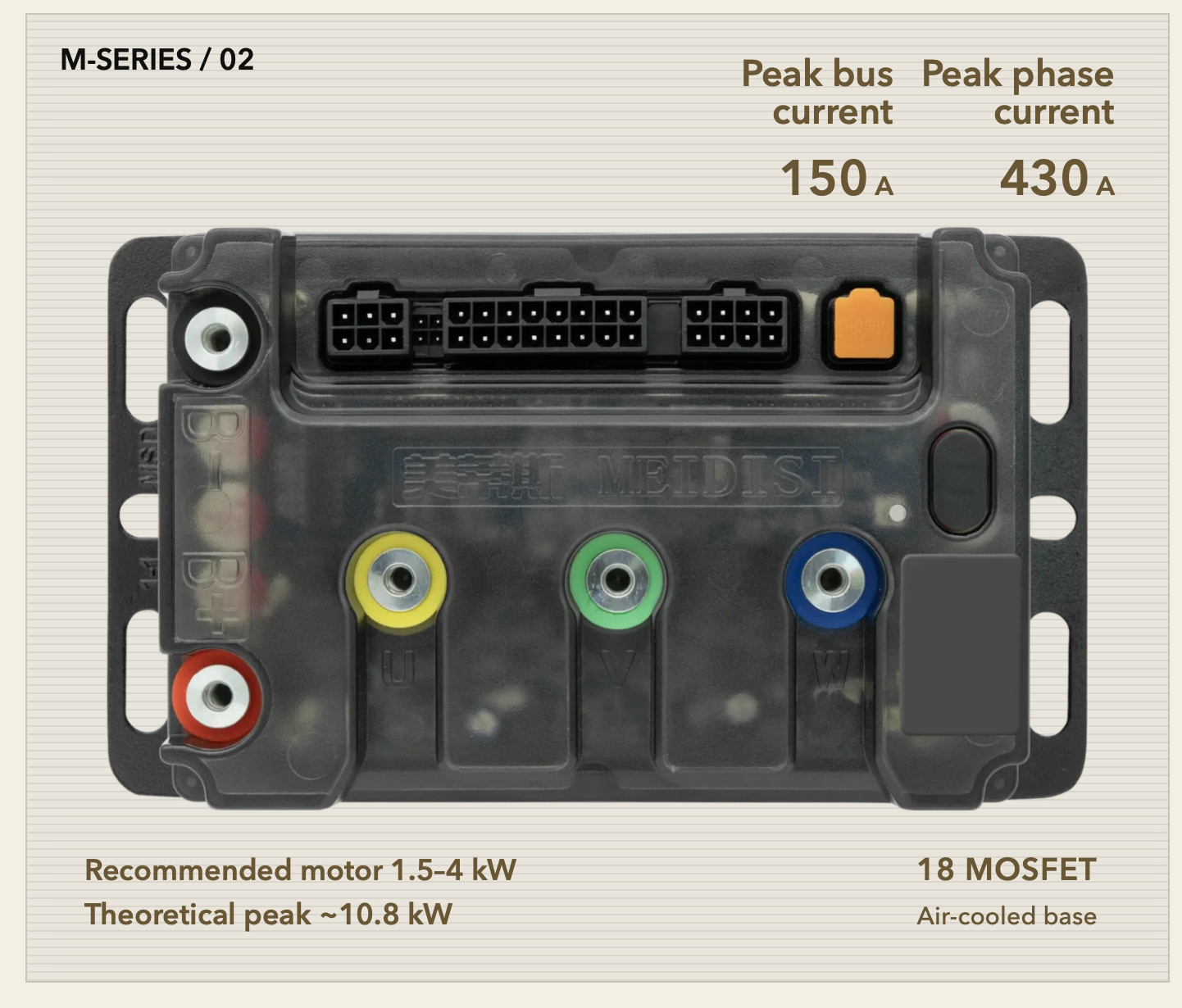
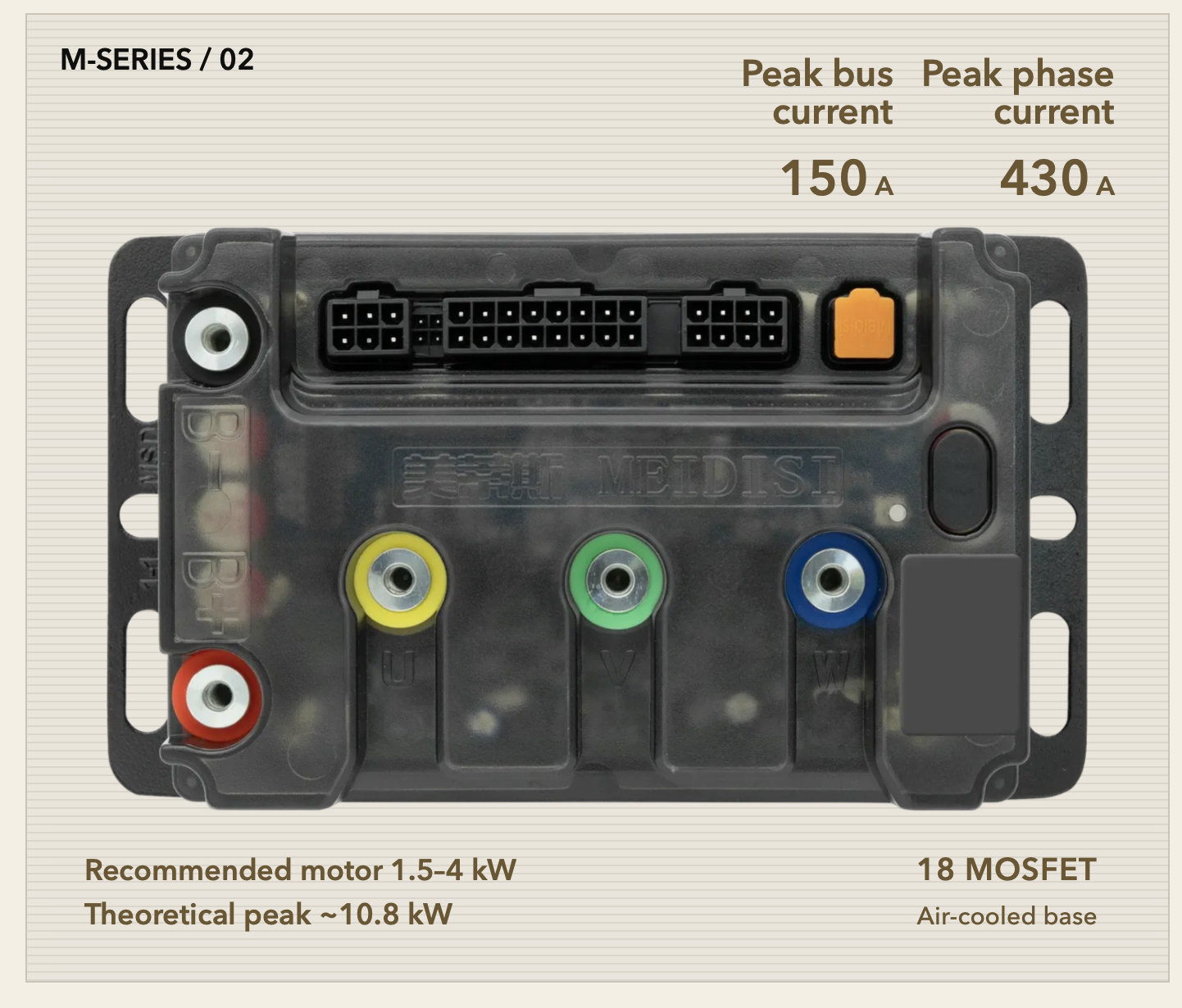
The MCS M430 uses 18 MOSFETs, with a maximum bus current of 150 A and a maximum phase current of 430 A. It supports 48–80 V nominal battery systems, up to 95 V at full charge, 1,500–4,000 W motors and 10,800 W maximum power.
Functions
Bluetooth tuning, approximately 30-second motor self-learning, BOOST, eTCS, OTA updates, 0–50 A adjustable EBS regeneration, cruise control, low-speed reverse, hill hold, hill-descent assistance and side-stand/READY interlock are supported. Availability and control behavior must match the selected vehicle version and firmware.
Fitment and ordering
Choose the version matched to your vehicle brand and model. Some vehicles require a dedicated adapter harness. Before ordering, confirm the vehicle model and year and provide clear photos of the display and controller connectors. Battery, BMS and motor compatibility must also be checked.
Performance reference
On confirmed M310/M430 applications, speed may increase by approximately 15–25 km/h compared with the original setup. The actual result depends on the battery, BMS, motor, vehicle load and tuning; this is not a guaranteed top speed.
Cooling
In the confirmed comparison test at 25 °C ambient temperature and 100 km/h for 20 km, the M430 reached 80 °C versus 100 °C for the comparison controller. Adding the optional dual-fan kit reduced temperature by a further approximately 10–15 °C under those test conditions. Actual temperature depends on load, installation and airflow. The M430 does not use the M560/M1000 water-cooling assembly.
Size and package
Controller size: 180 × 104 × 56 mm. Net weight: 1,135 g. Package size: 220 × 140 × 70 mm; gross weight: 1.45 kg. Standard package: M430 controller, Hall cable for modified motors, five insulating rubber pieces and two fixing screws. Adapter harnesses and the dual-fan kit are optional unless the selected version states otherwise.
Warranty
One-year warranty. Maximum current figures are peak limits, not continuous-output ratings.